Saturday, 25 January 2014

Snake Myths And Facts

Snake Myths And Facts

 1) Snakes Go Blind During the Heat of Summer

It still surprises me how many people believe this myth. Snakes do not simply go blind based on temperature or time of year. However, snakes close to shedding their skins do experience a temporary loss or inhibition of vision as their old ocular scales, protective scales covering the eyes, begin to separate from new ones developing underneath.

During this time, the eyes appear a milky gray-blue, and the snake’s ability to see is minimal. In captivity, this period of temporary blindness may happen anytime before a shed, but snakes in the wild typically do not always eat as much as their captive counterparts, so they often shed old skins less frequently. In nature, especially in the southern United States, a great many snakes slip into a shed cycle in late summer, so perhaps the myth that all snakes “go blind” was born during this time of year.

2)Snakes chase people.

 Many people who have spent time outdoors have a story about being chased by snakes. But herpetologists, people who study reptiles and amphibians, never seem to have this experience. They find that snakes are always trying to escape. To understand this perceived behavior of a snake chasing someone, one must first realize that a snake has nothing to gain by chasing a person. A snake obviously could not eat a person and so is not looking for food. They are not vengeful and do not chase people out of sheer hate

3) Rattlesnakes always add one rattle a year.

 A rattlesnake adds one rattle every time it sheds its skin. Snakes may shed several times in the course of a year, each time adding a new rattle. Rattles also may break off. Determining a snake's age by counting rattles usually results in an inaccurate estimate of the snake's age.

4)snakes drink milk.

The real fact is that snakes hate milk and it is scientifically proved that when snakes are forced to drink milk they get sick.
3. It is falsely believed that snakes can listen to music. Snakes never dance to the tune of the snake charmers. In fact snakes cannot hear the music it is the movement of the snake charmer that forces the snakes to follow a particular movement.

5)It is a common myth that snakes dance to been played by charmers.

Snakes are normally unresponsive. They are unable to hear the sounds that are transmitted in the air. Their body helps to catch the vibrations from the surface. Snakes believe that the moving charmer & his instruments are going to attack them so they quickly change their position & constantly sway their heads in the direction of instruments. This is a safeguard posture.

6) Bite received from a snake in water is not poisonous.

 Another false belief is that a bite received from a snake in water is not poisonous but the fact is that venomous snakes either when bitten on land or on water is equally poisonous.

 7)Many people believe that there are ‘Two-headed’ snakes.

This myth about ‘Two-headed’ snakes generally gets popularized by the snake-charmers who always try to prolong this mythological state about snakes in India so that they can persist in their job of attracting huge crowds towards their snake shows. Actually ‘Two-headed’ snake does not exist.

Friday, 24 January 2014

yellow-bellied sea snake (Pelamis platura)

 yellow-bellied sea snake (Pelamis platura)

 yellow-bellied sea snake (Pelamis platura)

Description:

The body of this snake is compressed, posteriorly less than half the diameter of the neck; the body scales are juxtaposed, subquadrangular in shape, and in 23–47 rows around thickest part of body; ventral scales, 264–406 in number, are very small and, if distinct, divided by a longitudinal groove, but usually are indistinguishable from adjacent body scales. The head is narrow, with an elongated snout; head shields are entire, nostrils are superior, and nasal shields are in contact with one another; the prefrontal scale is in contact with second upper labial; one or two preoculars, two or three postoculars, and two or three small anterior temporals are present; seven or eight upper labials are found, with four or five below the eye, but separated from the border by a subocular. Colors of the snake are variable, but most often distinctly bicolored, black above, yellow or brown below, with the dorsal and ventral colors sharply demarcated from one another; ventrally, there may be a series of black spots or bars on the yellow or brown background, or the yellow may extend dorsally so there is only a narrow middorsal black stripe, or a series of black crossbars (M.A. Smith, 1943: 476–477, gives more complete descriptions of the color pattern variants). Total length for males is up to 720 millimetres (28 in), for females up to 880 millimetres (35 in); tail length for males is up to 80 millimetres (3.1 in), females up to 90 millimetres (3.5 in).

sea snake

Venom:

The venom of this species is highly potent, like other sea snakes. In Australia, sea snakes are rarely aggressive and bites are uncommon. The subcutaneous LD50 of the venom is 0.067 mg/kg and the venom yield per bite is 1.0–4.0 mg

Habits:

 These snakes breed in warm waters; they are ovoviviparous with a gestation period of about six months. According to Ditmars, females bear live young in tidal pools.They are helpless on land, and they sometimes form large aggregations of thousands in surface waters. These snakes use their neurotoxic venom against their fish prey. No human fatalities from envenomation are known.

Antivenom:

Sea snake venom can cause damage to skeletal muscle with consequent myoglobinuria, neuromuscular paralysis or direct renal damage. The venoms of significant species of sea snake are neutralised with Commonwealth Serum Laboratories Ltd (of Melbourne, Australia) sea snake (Enhydrina schistosa) antivenom. If that preparation is not available, tiger snake or polyvalent antivenom should be used. No deaths have been recorded from bites in Australian waters.[18][19] The E. schistosa antivenom was tested specifically on Pelamus platurus, and it effectively neutralised the venom.

Thursday, 23 January 2014

Black Mamba HD Images Photos Wallpapers Free Download

Black Mamba HD Images Photos Wallpapers Free Download
 Black Mamba

Black Mamba 
Black Mamba

Wednesday, 25 April 2012

Bardick Snake (Echiopsis curta)

The bardick is a small snake found in leaf litter and among vegetation debris in semi-arid areas of the southern part of the continent. It is grey or grey-brown in colour and typically grows to no mre than about 60cm in length. The head is distinct, being broader tha the neck. It preys on small lizards, frogs and small mammals. Its venomous status is uncertain, but the venom has been found to have similarities with death adder venom. Females produce a litter of between 3 and 14 live young.


Description

The Bardic Snake is an evil Yuan-Ti character. The Yuan-Ti are known as a deceitful and controlling race, and so the idea of one who would sing lies in order to weaken an enemy is fitting, as is the Bard's use of enchantment spells to control enemies. This particular Yuan-Ti is also an experienced veteran warrior and has dabbled in necromancy (hence the Blackguard and Pale Master levels). Because of these factors, this particular build has very solid role-playing qualities. However, it is made also as a power build designed to gain both Epic Divine Might and Hymn of Requiem while achieving high saves, spell resistance, and AC as well as significant power with enchantment spells. It is extremely versatile, with countless options for how to approach a battle. As such, there are very few types of enemies that this character is hard-pressed to deal with. In fact, this build tested favorably against most builds I tested it against in the Battle of the Builds mod. This is remarkable considering 1v1 completely ignores the important party buffing aspect of Bards.


Part of the aim of this build is versatility. It is fun to have multiple viable options on how to approach a battle. The Bardic Snake can approach things in a lot of different ways. He can be use epic divine might to be a major melee damage dealer. He can pump up his defense with inspirations, songs, and spells to become a tank. He can debuff opponent's will saves and then throw out hard to resist enchantment spells. He can throw down a series of bombs like curse song, hymn of requiem, and ice storm and watch like a Wizard or Sorcerer does as his party mops up the severely weakened/damaged enemies. Inspire Regeneration can make him a poor man's cleric between battles. Pumping up Hide and Move Silently (which I dont do, but is certainly possible) and using inspire competence or using invisibility can make him a good scout. Inspire competence in conjunction with sleight of hand or appraise or a conversation skill can get you things you want more easily. With a high Use Magic Device, your battle options extend to any arcane OR divine spell that can be found on a scroll or wand! The Bardic Snake will also be the major buffer for your party like any other Bard. The options are just endless with this character! You can be creative too. For instance, I recently discovered that with NWN2s dumb AI, it is a legitimate strategy to use Inspire Slowness and then have your Bard run in and draw all the aggro of a group. He can run around without getting caught while the rest of your party gets easy attacks of opportunity and sneak attacks on the chasing enemies without taking damage. If your party's health is too low to win a battle head on, this Bard tactic can be a lifesaver. Anyways, let's get down to the essentials:


Range

E. curta ranges from southern Western Australia through South Australia, and west to Victoria and New South Wales. It is listed as Near Threatened by the IUCN..


Habitat

E. curtis inhabit semiarid grasslands and shrublands. They are usually found under rocks, debris, fallen vegetation, etc.

Food and Venom

The species is nocturnal. They prey upon a wide variety of rodents, lizards, amphibians, and sometimes birds and insects- an unusual variety for a small elapid. These snakes are venomous, and, like all elapids, inject their venom swiftly through fangs placed in the front of the jaw.


Reproduction

Little is known about either of these snakes' reproductive habits except that Bardicks are ovoviviparous, and that females give birth to anywhere from 3-14 young around August.

Monday, 26 March 2012

Acanthophis hawkei (Barkly Tableland Death Adder)

Acanthophis is a genus of elapid snakes. Commonly called death adders, they are native to Australia, New Guinea and nearby islands, and are among the most venomous snakes in the world. The name of the genus derives from the Ancient Greek acanthos/ἄκανθος "spine" and ophis/ὄφις "snake", referring to the spine on the death adder's tail.

Seven species are listed by ITIS,[1] though it remains unclear how many species this genus includes, with figures ranging from 4 to 15 species being quoted


Description

Death adders are very viper-like in appearance, having a short, robust body, triangular shaped heads and small subocular scales. They also have vertical pupils and many small scales on the top of the head. Their fangs are also longer and more mobile than for most other elapids, although still far from the size seen in some of the true vipers. Despite their name and appearance, they are not vipers at all. This is a case of convergent evolution.

They normally take 2–3 years to reach adult size. Females are generally slightly larger than the males. They can also be easily distinguished from other Australian snakes because of a small, worm like lure on the end of their tail, which is used to attract prey. Most have large bands around their bodies, though the color itself is variable, depending on their locality. Colors are usually black, grey or red and yellow, but also include brown and greenish-grey


Hunting

Unlike most snakes, death adders do not actively hunt, but rather lie in ambush and draw their prey to them. When hungry, death adders bury themselves amongst the substrate. This may be leaf litter, soil or sand, depending on their environment. The only part of themselves they expose are their head and their tail, both generally very well camouflaged. The end of the tail is used for caudal luring and when wiggled is easily mistaken for a grub or worm. An unsuspecting bird or mammal will eventually notice the 'easy lunch' and attempt to seize it. Only then will the death adder move, lashing out with the quickest strike of any snake in the world.[2] A death adder can go from a strike position, to strike and envenoming their prey, and back to strike position again, in less than 0.15 of a second.


Venom

Death adders can inject on average 40–100 mg of highly toxic venom with a bite. The LD50 of the venom was reported as 0.4–0.5 mg/kg subcutaneous and it is completely neurotoxic, containing neither haemotoxins nor myotoxins, unlike most venomous snakes.

A bite from a death adder can cause paralysis which seems minor at first but can cause death from a complete respiratory shutdown in six hours. Symptoms of envenomation can be reversed through the use of death adder antivenom, or using anticholinesterases, which break the synaptic blockade by making acetylcholine more available to the parasympathetic nervous system, thus mitigating the effects of the venom.

Before antivenom was introduced, it is reported that about 50% of death adder bites were fatal. Deaths are much rarer nowadays as the anti-venom is widely available and the progression of envenomation symptoms is slow.


Tuesday, 20 March 2012

Red Spitting Cobra

Description

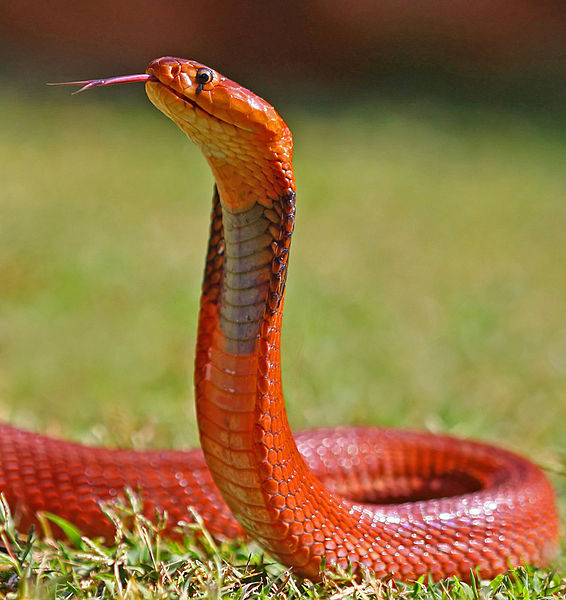
This relatively medium-sized cobra attains lengths between 0.7 and 1.2 meters (2.3 and 3.9 ft),[1][2] but may grow to a maximum length of around 1.5 meters (4.9 ft) in very rare cases.[2][3] It is often thought of as an attractive species; it is usually bright salmon-red contrasted with a broad black throat band and subocular teardrop markings.[1] However, the colour of this species does have variation, which usually depends on where in Africa a particular specimen is found. For example, specimens from southern Kenya and northern Tanzania have an orange-red colour, with a broad, dark blue or black throat band. Some specimens may have two or three throat bands, but this is uncommon for specimens from East Africa. The ventral side is also reddish in colour, sometimes the throat area may be a creamy white. Specimens from other areas can be yellow, pinkish, pink-grey, pale red or steel grey. Most specimens will have a throat band, but it will fade or even sometimes disappear in larger adults. The true red specimens will become reddish-brown in colour as they age and grow in size.[2] The body of this snake is slightly depressed, tapered and moderately slender with a medium-length tail. It is slightly compressed dorsoventrally and subcylindrical posteriorly. The head is broad, flattened and slightly distinct from the neck. The canthus is distinct and the snout is rounded. The eyes are medium to large in size with round pupils. Dorsal scales are smooth and strongly oblique.


Scalation

Dorsal scales on the midbody are in 21–27, ventrals are in 197–228, and subcaudals are in 61–72 rows, subscales are paired, and the anal scale is single. There are seven upper labials, one upper labial enters the eye; two preoculars, three postoculars, and the lower labials are usually eight in number (range 7-9).

Distribution and habitat

The red spitting cobra is mainly found in East Africa, including Djibouti, Eritrea, Somalia, southern Egypt, northern and eastern Ethiopia, and northern Tanzania and northern Sudan. It is also widespread in the dry country of eastern and northern Kenya. It primarily inhabits dry savanna and semidesert areas of East Africa up to an elevation of about 1,200 metres (3,900 ft) above sea level. They can usually be found near water holes.


Behavior

Red spitting cobras are terrestrial, fast and alert snakes. Adults specimens of this species are nocturnal, while juveniles are more active during the day. Adults like to hide in termite mounds, old logs, holes, brush piles or any other ground cover during the day.[3] They are also known to be cannibalistic; this could be the reason juveniles and smaller specimens are diurnal while adults are nocturnal.[2]

When threatened, this cobra rears up and displays a typical cobra hood. It may also hiss loudly. If the intruder does not retreat, it may sprays jets of venom to the face of the intruder. Venom that gets into the eyes can cause burning pain and blindness. Even so, this snake seldom causes fatalities in humans.

Diet

This species has a wide range of prey, but they prefer amphibians such as toads and frogs, if and when they are available. However, they will prey on rodents, birds[1] and probably others snakes. They are known to raid chicken runs in the region.


Reproduction

The red spitting cobra is oviparous. The female will lay six to 15 eggs.

Venom

The venom of this species, like most spitting cobras, contains a mixture of neurotoxins and cytotoxins. Bite symptoms include slight pain around the wound and numbness of lips and tongue. Although it rarely causes human fatalities, survivors are usually disfigured.[1] The murine IP LD50 value for this snake is 2 mg/kg.[4]

In September 2011, a snake keeper from the Eastern Cape in South Africa died shortly after a red spitting cobra sprayed venom into his face whilst he and a friend were photographing the snake. Some of the venom was believed to have entered his nasal passages and led to anaphylactic shock. His being asthmatic is believed to have contributed to his fatal reaction.


Saturday, 4 February 2012

Farancia (Mud Snake)

Farancia is a genus of colubrid snakes. It consists of two species, one commonly referred to as the rainbow snake and the other commonly referred to as the mud snake. They are native to the eastern half of the United States.

Description

Farancia species can grow to a length of 30-54 inches. They are usually uniform dark brown or black with a brightly colored underside that is red or orange. Rainbow snakes exhibit red striping down their back.

Behaviour
The snakes of this genus are typically semi-aquatic. Living in the muddy edges of slow moving, permanent water sources. Their diet consists primarily of amphiumas, eels, and sirens. Breeding occurs in early spring, and eggs are laid in a burrow near the water in early summer. The clutch incubates between 8–12 weeks, and hatches in mid-autumn.


Species

    Farancia abacura - Texas, Arkansas, Louisiana, Mississippi, Alabama, Georgia, Florida, North and South Carolina, Virginia, Tennessee, Missouri, Illinois, and Kentucky.
        Eastern Mud Snake, Farancia abacura abacura (Holbrook, 1836)
        Western Mud Snake, Farancia abacura reinwardtii (Schlegel, 1837)
    Farancia erytrogramma - Louisiana, Mississippi, Alabama, Georgia, Florida, North and South Carolina, Virginia, and Maryland.
        Rainbow Snake, Farancia erytrogramma erytrogramma (Palisot de Beauvois, 1802)
        Florida Rainbow Snake, Farancia erytrogramma seminola (Neill, 1964)


Geographic range

The mud snake is found primarily in the southeastern United States, in the states of Texas, Arkansas, Oklahoma, Louisiana, Mississippi, Alabama, Georgia, Florida, North and South Carolina, Virginia, Tennessee, Missouri, Illinois, and Kentucky.


Cultural Significance

The mud snake is one of a few animals which may be the origin of the hoop snake myth. J.D. Wilson Writes:
“     Mud snakes are sometimes known as “hoop snakes” because of the myth that they will bite their own tail and roll after people.[1]     ”

The hoop snake myth has also been attributed to the Coachwhip snake.