Description
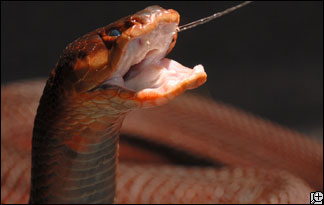
This relatively medium-sized cobra attains lengths between 0.7 and 1.2 meters (2.3 and 3.9 ft),[1][2] but may grow to a maximum length of around 1.5 meters (4.9 ft) in very rare cases.[2][3] It is often thought of as an attractive species; it is usually bright salmon-red contrasted with a broad black throat band and subocular teardrop markings.[1] However, the colour of this species does have variation, which usually depends on where in Africa a particular specimen is found. For example, specimens from southern Kenya and northern Tanzania have an orange-red colour, with a broad, dark blue or black throat band. Some specimens may have two or three throat bands, but this is uncommon for specimens from East Africa. The ventral side is also reddish in colour, sometimes the throat area may be a creamy white. Specimens from other areas can be yellow, pinkish, pink-grey, pale red or steel grey. Most specimens will have a throat band, but it will fade or even sometimes disappear in larger adults. The true red specimens will become reddish-brown in colour as they age and grow in size.[2] The body of this snake is slightly depressed, tapered and moderately slender with a medium-length tail. It is slightly compressed dorsoventrally and subcylindrical posteriorly. The head is broad, flattened and slightly distinct from the neck. The canthus is distinct and the snout is rounded. The eyes are medium to large in size with round pupils. Dorsal scales are smooth and strongly oblique.
 Scalation
Dorsal scales on the midbody are in 21–27, ventrals are in 197–228, and subcaudals are in 61–72 rows, subscales are paired, and the anal scale is single. There are seven upper labials, one upper labial enters the eye; two preoculars, three postoculars, and the lower labials are usually eight in number (range 7-9).
Distribution and habitat
The red spitting cobra is mainly found in East Africa, including Djibouti, Eritrea, Somalia, southern Egypt, northern and eastern Ethiopia, and northern Tanzania and northern Sudan. It is also widespread in the dry country of eastern and northern Kenya. It primarily inhabits dry savanna and semidesert areas of East Africa up to an elevation of about 1,200 metres (3,900 ft) above sea level. They can usually be found near water holes.
 Behavior
Red spitting cobras are terrestrial, fast and alert snakes. Adults specimens of this species are nocturnal, while juveniles are more active during the day. Adults like to hide in termite mounds, old logs, holes, brush piles or any other ground cover during the day.[3] They are also known to be cannibalistic; this could be the reason juveniles and smaller specimens are diurnal while adults are nocturnal.[2]
When threatened, this cobra rears up and displays a typical cobra hood. It may also hiss loudly. If the intruder does not retreat, it may sprays jets of venom to the face of the intruder. Venom that gets into the eyes can cause burning pain and blindness. Even so, this snake seldom causes fatalities in humans.
Diet
This species has a wide range of prey, but they prefer amphibians such as toads and frogs, if and when they are available. However, they will prey on rodents, birds[1] and probably others snakes. They are known to raid chicken runs in the region.
 Reproduction
The red spitting cobra is oviparous. The female will lay six to 15 eggs.
Venom
The venom of this species, like most spitting cobras, contains a mixture of neurotoxins and cytotoxins. Bite symptoms include slight pain around the wound and numbness of lips and tongue. Although it rarely causes human fatalities, survivors are usually disfigured.[1] The murine IP LD50 value for this snake is 2 mg/kg.[4]
In September 2011, a snake keeper from the Eastern Cape in South Africa died shortly after a red spitting cobra sprayed venom into his face whilst he and a friend were photographing the snake. Some of the venom was believed to have entered his nasal passages and led to anaphylactic shock. His being asthmatic is believed to have contributed to his fatal reaction.


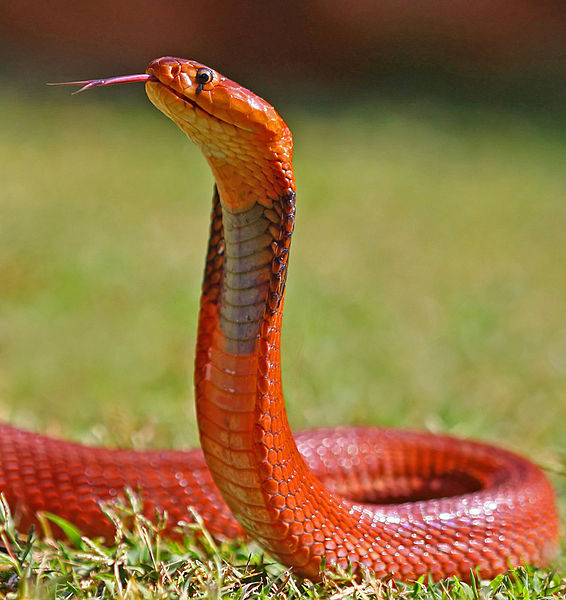
This relatively medium-sized cobra attains lengths between 0.7 and 1.2 meters (2.3 and 3.9 ft),[1][2] but may grow to a maximum length of around 1.5 meters (4.9 ft) in very rare cases.[2][3] It is often thought of as an attractive species; it is usually bright salmon-red contrasted with a broad black throat band and subocular teardrop markings.[1] However, the colour of this species does have variation, which usually depends on where in Africa a particular specimen is found. For example, specimens from southern Kenya and northern Tanzania have an orange-red colour, with a broad, dark blue or black throat band. Some specimens may have two or three throat bands, but this is uncommon for specimens from East Africa. The ventral side is also reddish in colour, sometimes the throat area may be a creamy white. Specimens from other areas can be yellow, pinkish, pink-grey, pale red or steel grey. Most specimens will have a throat band, but it will fade or even sometimes disappear in larger adults. The true red specimens will become reddish-brown in colour as they age and grow in size.[2] The body of this snake is slightly depressed, tapered and moderately slender with a medium-length tail. It is slightly compressed dorsoventrally and subcylindrical posteriorly. The head is broad, flattened and slightly distinct from the neck. The canthus is distinct and the snout is rounded. The eyes are medium to large in size with round pupils. Dorsal scales are smooth and strongly oblique.
Dorsal scales on the midbody are in 21–27, ventrals are in 197–228, and subcaudals are in 61–72 rows, subscales are paired, and the anal scale is single. There are seven upper labials, one upper labial enters the eye; two preoculars, three postoculars, and the lower labials are usually eight in number (range 7-9).
Distribution and habitat
The red spitting cobra is mainly found in East Africa, including Djibouti, Eritrea, Somalia, southern Egypt, northern and eastern Ethiopia, and northern Tanzania and northern Sudan. It is also widespread in the dry country of eastern and northern Kenya. It primarily inhabits dry savanna and semidesert areas of East Africa up to an elevation of about 1,200 metres (3,900 ft) above sea level. They can usually be found near water holes.

Red spitting cobras are terrestrial, fast and alert snakes. Adults specimens of this species are nocturnal, while juveniles are more active during the day. Adults like to hide in termite mounds, old logs, holes, brush piles or any other ground cover during the day.[3] They are also known to be cannibalistic; this could be the reason juveniles and smaller specimens are diurnal while adults are nocturnal.[2]
When threatened, this cobra rears up and displays a typical cobra hood. It may also hiss loudly. If the intruder does not retreat, it may sprays jets of venom to the face of the intruder. Venom that gets into the eyes can cause burning pain and blindness. Even so, this snake seldom causes fatalities in humans.
Diet
This species has a wide range of prey, but they prefer amphibians such as toads and frogs, if and when they are available. However, they will prey on rodents, birds[1] and probably others snakes. They are known to raid chicken runs in the region.

The red spitting cobra is oviparous. The female will lay six to 15 eggs.
Venom
The venom of this species, like most spitting cobras, contains a mixture of neurotoxins and cytotoxins. Bite symptoms include slight pain around the wound and numbness of lips and tongue. Although it rarely causes human fatalities, survivors are usually disfigured.[1] The murine IP LD50 value for this snake is 2 mg/kg.[4]
In September 2011, a snake keeper from the Eastern Cape in South Africa died shortly after a red spitting cobra sprayed venom into his face whilst he and a friend were photographing the snake. Some of the venom was believed to have entered his nasal passages and led to anaphylactic shock. His being asthmatic is believed to have contributed to his fatal reaction.