Showing posts with label dangerous snakes. Show all posts

Thursday, 30 January 2014

Puerto Rican Boa

Puerto Rican Boa

Puerto Rican Boa

 Description:

The Puerto Rican Boa or "culebr" is the largest native species of snake, and one of only three Boidae on the island. It typically grows to a length of 6 or 7 feet, although 12 foot long specimens have been reported. The Boa's color varies from tan to dark brown with 70 to 80 crossbars or spots which are outlined in very dark brown. 

Puerto Rican Boa

 Reproduction:

Pregnant females give birth to about 23-26 live young boas. Young boas have never been kept in captivity because their feeding patterns have never been studied.

Puerto Rican Boa

 Habitat:

The Puerto Rican Boa may be found on the ground or in trees. In some areas of the forest the Boa hangs from branches, vines and rock ledges at the mouths of caves and when bats brush by them or collide with them they capture and eat them.

 Feeding Behavior:

The boa feeds by seizing the prey in its jaws, wrapping several coils around the victim, and then constricting until the prey has suffocated. The prey is then swallowed head first. The feeding habits of the very young are unknown.

Since the karst region in which the Puerto Rican boa lives usually has many caves, the boa has the opportunity to feed on bats. It was previously unknown how the boa managed to capture the bats in flight. Observations revealed that boas hang at the opening of the cave, waiting until bats fly out of it. Then they grab a bat with their jaws before killing it via constriction.

Wednesday, 29 January 2014

Rufous beaked snake

Rufous beaked snake

 Description:

  The rufous beaked snake is large and stout, with males reaching a maximum length of 1.1 m (3.6 ft) and females reaching 1.07 m (3.5 ft). It has a shortened skull, as with all beaked snakes, giving it a clear distinction between its head and body, as well as a dark brown eye stripe running down the side of its head.[6] Its eyes are large with round pupils. While its back tends to be yellowish-brown to reddish-brown, its belly is cream or yellowish-white.

 Geographic range:

The rufous beaked snake's range includes north Botswana, north Zimbabwe, Mozambique, Tanzania, and Sudan. 


 Biology:

 Diurnal animals, rufous beaked snakes hunt small animals, including other snakes, but stay in burrows during the hottest part of the day. In the summer, females lay eight to 17 cylindrical eggs with dimensions of about 36 mm × 21 mm (1.4 in × 0.83 in) over the span of several days.The snake's venom, one of its components of which is a neurotoxin called rufoxin, causes hypotension and circulatory shock in small mammals, but is not dangerous to humans.

 
Venom:

Although this snake is mildly venomous it poses no danger to man and hardly even attempts to bite. 


Saturday, 25 January 2014

Snake Myths And Facts

Snake Myths And Facts

 1) Snakes Go Blind During the Heat of Summer

It still surprises me how many people believe this myth. Snakes do not simply go blind based on temperature or time of year. However, snakes close to shedding their skins do experience a temporary loss or inhibition of vision as their old ocular scales, protective scales covering the eyes, begin to separate from new ones developing underneath.

During this time, the eyes appear a milky gray-blue, and the snake’s ability to see is minimal. In captivity, this period of temporary blindness may happen anytime before a shed, but snakes in the wild typically do not always eat as much as their captive counterparts, so they often shed old skins less frequently. In nature, especially in the southern United States, a great many snakes slip into a shed cycle in late summer, so perhaps the myth that all snakes “go blind” was born during this time of year.

2)Snakes chase people.

 Many people who have spent time outdoors have a story about being chased by snakes. But herpetologists, people who study reptiles and amphibians, never seem to have this experience. They find that snakes are always trying to escape. To understand this perceived behavior of a snake chasing someone, one must first realize that a snake has nothing to gain by chasing a person. A snake obviously could not eat a person and so is not looking for food. They are not vengeful and do not chase people out of sheer hate

3) Rattlesnakes always add one rattle a year.

 A rattlesnake adds one rattle every time it sheds its skin. Snakes may shed several times in the course of a year, each time adding a new rattle. Rattles also may break off. Determining a snake's age by counting rattles usually results in an inaccurate estimate of the snake's age.

4)snakes drink milk.

The real fact is that snakes hate milk and it is scientifically proved that when snakes are forced to drink milk they get sick.
3. It is falsely believed that snakes can listen to music. Snakes never dance to the tune of the snake charmers. In fact snakes cannot hear the music it is the movement of the snake charmer that forces the snakes to follow a particular movement.

5)It is a common myth that snakes dance to been played by charmers.

Snakes are normally unresponsive. They are unable to hear the sounds that are transmitted in the air. Their body helps to catch the vibrations from the surface. Snakes believe that the moving charmer & his instruments are going to attack them so they quickly change their position & constantly sway their heads in the direction of instruments. This is a safeguard posture.

6) Bite received from a snake in water is not poisonous.

 Another false belief is that a bite received from a snake in water is not poisonous but the fact is that venomous snakes either when bitten on land or on water is equally poisonous.

 7)Many people believe that there are ‘Two-headed’ snakes.

This myth about ‘Two-headed’ snakes generally gets popularized by the snake-charmers who always try to prolong this mythological state about snakes in India so that they can persist in their job of attracting huge crowds towards their snake shows. Actually ‘Two-headed’ snake does not exist.

Tuesday, 20 March 2012

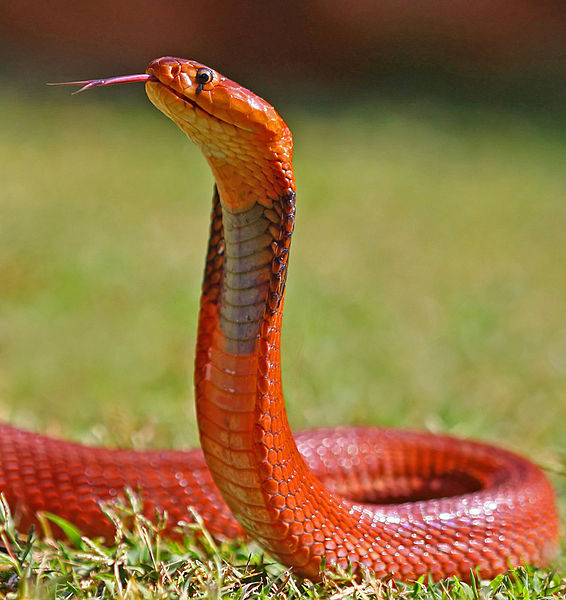
Red Spitting Cobra

Description

This relatively medium-sized cobra attains lengths between 0.7 and 1.2 meters (2.3 and 3.9 ft),[1][2] but may grow to a maximum length of around 1.5 meters (4.9 ft) in very rare cases.[2][3] It is often thought of as an attractive species; it is usually bright salmon-red contrasted with a broad black throat band and subocular teardrop markings.[1] However, the colour of this species does have variation, which usually depends on where in Africa a particular specimen is found. For example, specimens from southern Kenya and northern Tanzania have an orange-red colour, with a broad, dark blue or black throat band. Some specimens may have two or three throat bands, but this is uncommon for specimens from East Africa. The ventral side is also reddish in colour, sometimes the throat area may be a creamy white. Specimens from other areas can be yellow, pinkish, pink-grey, pale red or steel grey. Most specimens will have a throat band, but it will fade or even sometimes disappear in larger adults. The true red specimens will become reddish-brown in colour as they age and grow in size.[2] The body of this snake is slightly depressed, tapered and moderately slender with a medium-length tail. It is slightly compressed dorsoventrally and subcylindrical posteriorly. The head is broad, flattened and slightly distinct from the neck. The canthus is distinct and the snout is rounded. The eyes are medium to large in size with round pupils. Dorsal scales are smooth and strongly oblique.


Scalation

Dorsal scales on the midbody are in 21–27, ventrals are in 197–228, and subcaudals are in 61–72 rows, subscales are paired, and the anal scale is single. There are seven upper labials, one upper labial enters the eye; two preoculars, three postoculars, and the lower labials are usually eight in number (range 7-9).

Distribution and habitat

The red spitting cobra is mainly found in East Africa, including Djibouti, Eritrea, Somalia, southern Egypt, northern and eastern Ethiopia, and northern Tanzania and northern Sudan. It is also widespread in the dry country of eastern and northern Kenya. It primarily inhabits dry savanna and semidesert areas of East Africa up to an elevation of about 1,200 metres (3,900 ft) above sea level. They can usually be found near water holes.


Behavior

Red spitting cobras are terrestrial, fast and alert snakes. Adults specimens of this species are nocturnal, while juveniles are more active during the day. Adults like to hide in termite mounds, old logs, holes, brush piles or any other ground cover during the day.[3] They are also known to be cannibalistic; this could be the reason juveniles and smaller specimens are diurnal while adults are nocturnal.[2]

When threatened, this cobra rears up and displays a typical cobra hood. It may also hiss loudly. If the intruder does not retreat, it may sprays jets of venom to the face of the intruder. Venom that gets into the eyes can cause burning pain and blindness. Even so, this snake seldom causes fatalities in humans.

Diet

This species has a wide range of prey, but they prefer amphibians such as toads and frogs, if and when they are available. However, they will prey on rodents, birds[1] and probably others snakes. They are known to raid chicken runs in the region.


Reproduction

The red spitting cobra is oviparous. The female will lay six to 15 eggs.

Venom

The venom of this species, like most spitting cobras, contains a mixture of neurotoxins and cytotoxins. Bite symptoms include slight pain around the wound and numbness of lips and tongue. Although it rarely causes human fatalities, survivors are usually disfigured.[1] The murine IP LD50 value for this snake is 2 mg/kg.[4]

In September 2011, a snake keeper from the Eastern Cape in South Africa died shortly after a red spitting cobra sprayed venom into his face whilst he and a friend were photographing the snake. Some of the venom was believed to have entered his nasal passages and led to anaphylactic shock. His being asthmatic is believed to have contributed to his fatal reaction.


Saturday, 4 February 2012

Farancia (Mud Snake)

Farancia is a genus of colubrid snakes. It consists of two species, one commonly referred to as the rainbow snake and the other commonly referred to as the mud snake. They are native to the eastern half of the United States.

Description

Farancia species can grow to a length of 30-54 inches. They are usually uniform dark brown or black with a brightly colored underside that is red or orange. Rainbow snakes exhibit red striping down their back.

Behaviour
The snakes of this genus are typically semi-aquatic. Living in the muddy edges of slow moving, permanent water sources. Their diet consists primarily of amphiumas, eels, and sirens. Breeding occurs in early spring, and eggs are laid in a burrow near the water in early summer. The clutch incubates between 8–12 weeks, and hatches in mid-autumn.


Species

    Farancia abacura - Texas, Arkansas, Louisiana, Mississippi, Alabama, Georgia, Florida, North and South Carolina, Virginia, Tennessee, Missouri, Illinois, and Kentucky.
        Eastern Mud Snake, Farancia abacura abacura (Holbrook, 1836)
        Western Mud Snake, Farancia abacura reinwardtii (Schlegel, 1837)
    Farancia erytrogramma - Louisiana, Mississippi, Alabama, Georgia, Florida, North and South Carolina, Virginia, and Maryland.
        Rainbow Snake, Farancia erytrogramma erytrogramma (Palisot de Beauvois, 1802)
        Florida Rainbow Snake, Farancia erytrogramma seminola (Neill, 1964)


Geographic range

The mud snake is found primarily in the southeastern United States, in the states of Texas, Arkansas, Oklahoma, Louisiana, Mississippi, Alabama, Georgia, Florida, North and South Carolina, Virginia, Tennessee, Missouri, Illinois, and Kentucky.


Cultural Significance

The mud snake is one of a few animals which may be the origin of the hoop snake myth. J.D. Wilson Writes:
“     Mud snakes are sometimes known as “hoop snakes” because of the myth that they will bite their own tail and roll after people.[1]     ”

The hoop snake myth has also been attributed to the Coachwhip snake.


Friday, 20 January 2012

Most Venomous Snakes in the World


 1.Taipan (Oxyuranus scutellatus): It is one of the most venomous and deadliest snakes in the world. There are three main sub-species of Taipan such as Papuan Taipan (Oxyuranus s. canni), Western or Inland Taipan (Oxyuranus Microlepidotus) or (Fierce Snake) and Common or Coastal Taipan (Oxyuranus Scutellatus). Taipans are found in Australia and New Guinea. Fierce snake or Inland Taipan is more toxic as compared to Papuan Taipan and Coastal Taipan. Inland Taipan is olive or brown in appearance, with uniformly black head or black marking on the head. Its habitat is grasslands and dry plains. Common or Coastal Taipan is dark or light brown in color with a paler shade on the sides and underside and lightly keeled scales. It is about 6 ft in length. It is found in the open woodlands and forests.

 2. Krait: This highly poisonous snake is found in Asia. It appears black or bluish-black in color with a white narrow cross-bands and a narrow head. Its average length is about 90cms. It is more active at night than during the day. It is 15 times more deadly than the common cobra. Its venom is a powerful neurotoxin, which causes the respiratory failure.
 
3. King cobra: It is world's largest venomous snake. Its average length is about 3.5 meters and it can be maximum 5.5 meters long. It appears uniformly brown, olive or green in color with black cross-bands. King cobra is commonly found in Southern China, Thailand, Philippines, South India and Malaysia Peninsula. Its venom is a neurotoxin type.
 
4. Russell's viper: Russell's viper is more commonly found in India, Sri Lanka, Malaysian Peninsula, Southern China, Sumatra, Java, Borneo and surrounding islands. It has a light brown body with three rows of black or brown splotches having white or yellow border. Its average length is about 1 meter. It is responsible for relatively more human deaths than any other types of venomous snake. While attacking, it coils tightly, hisses and strikes with such a high speed that its victim gets little chance to escape. Its venom is of hemotoxin type, which is a powerful coagulant, causing damage to blood cells and tissues.
  
5. Black Mamba: It is Africa's most feared venomous snake. It is found in Africa's open woodlands and African savannas. It is highly toxic and notoriously aggressive. Its venom is a powerful neurotoxin. It appears uniformly black or brown. Its average length is about 4.3 meters. Its mouth has a black internal lining. It is known as world's fastest land snake with the top speed of 16-19 km/hr.

 6.Tiger snake: It is olive or dark brown in color with olive or yellowish belly and cross-bands. Its subspecies are found in Victoria and Tasmania and it is uniformly black. Its average length is about 1.2 to 1.8 meters. It is one of the most venomous snakes found in Australia. It is also found in New Guinea, Tasmania and Bass Strait Islands. Its venom is a potent neurotoxin that affects the central nervous system. It produces venom in high quantities, with an average yield of about 35 mg to 180 mg.
  
7. Western Brown Snake (Pseudonaja nuchalis): It is found in the grasslands, forests, deserts and gravelly plains. It is a native of Australia. It has a narrow black head and black neck. It may be black or light brown in color with narrow dark crossbars or a series of lighter bands around the body. It is about 1.5 meters in length. Its venom is neurotoxic.

Rough Scaled Bush Viper (Atheris hispida)

Atheris hispida is a venomous viper species found in Central Africa. Known for its extremely keeled scales that give it an almost bristly appearance.[3] No subspecies are currently recognized.

 Description

The males of this species grow to maximum length of 73 cm (body 58 cm, tail 15 cm). Females grow to a maximum of 58 cm. The males are surprisingly long and slender compared to the females.

The head has a short snout, more so in males than in females. The eyes are large and surrounded by 9-16 circumorbital scales. Orbits separated by 7-9 scales. The nostril is like a slit and separated from the eye by two scales. The eye and the supralabials are separated by a single row of scales. The supralabials number 7-10, of which the fourth is enlarged.[3] The body is covered with elongated, heavily keeled scales that give this species a "shaggy", almost bristly appearance. The scales around the head and neck are the longest, decreasing posteriorly. Midbody, the dorsal scales number 15-19. There are 149-166 ventral scales and 35-64 subcaudals. The anal scale is single.


Common names

Rough-scaled bush viper, spiny bush viper, hairy bush viper, rough-scaled tree viper,African hairy bush viper, hairy viper.

The common name "hairy bush viper" should, however, be avoided for this species, as it will likely be confused with the recently described species, A. hirsuta, the specific name for which means "hairy".


Geographic range

Central Africa: DR Congo, south-west Uganda, west Kenya. The type locality given is "Lutunguru, Kivu" (DR Congo).[1]

More specifically, Spawls & Branch (1995) describe the distribution as isolated populations in Kivu and Orientale Provinces in DR Congo, southeastern Ruwenzori in Uganda and the Kakamega Forest in western Kenya.


Behavior

Capable of climbing reeds and stalks, this species is often found basking on top of flowers and terminal leaves. Mostly nocturnal.

 Feeding

Feeds on mammals, frogs, lizards and sometimes birds. Sometimes hunts for mammalian prey on the ground.


Monday, 21 November 2011

Sonora Semiannulata(GROUND SNAKE)

The common ground snake (Sonora semiannulata) is a species of small, harmless colubrid snake. It is sometimes referred to as the Western ground snake or variable ground snake as its patterning and coloration can vary widely, even within the same geographic region.

Description

Ground snakes can grow from 10 to 15 inches in length. Their colors and patterns can vary widely. They can be brown, red, or orange, with black banding, orange or brown striping, or be solid-colored. Their underside is typically white or grey. They have fairly smooth scales, a small head, and eyes with round pupils.

Habitat

Their preferred habitat is dry, rocky areas with loose soil.

Behavior

Ground snakes are typically nocturnal and secretive, but they are common throughout their range. They are often found on roadsides, or in dry drainage ditches at night, foraging for food.


Diet

Their diet consists primarily of invertebrates, such as spiders, scorpions, centipedes, crickets, and insect larvae.

Reproduction

They are oviparous, breeding and laying eggs through the summer months.

Taxonomy

Sonora semiannulata was once broken up into five separate subspecies, based on the vast differences in color and patterning that the species displays, but recent research has shown that the various colors and patterns of ground snake interbreed indiscriminantly, making distinction between them impossible and thus not warranting subspecies status, though some sources still refer to them - using geography as a basis rather than morphology.


ground snake


Beauty Rat Snake(elaphe taeniura)

The Beauty Rat Snake (Orthriophis taeniurus) is a species of long, slender, semi-arboreal snakes that are native to Asia. Their average length is about 5-7 feet, with an unofficial record of slightly under 10 ft. In captivity some calm down to be nice pets, but others have been known to be quite temperamental even many years after capture.

elaphe taeniura bleue
Coloration

Ground color of yellowish-brown to olive. The tops of the head and neck are unicolor. The markings on the back almost always consist of two pairs of black rounded spots, which join together. From each eye there is a dark stripe, which extends to the corners of the mouth. The upper labials are yellowish-white. In addition, this subspecies has a much wider head and a longer tail.


Breeding

The temperature for hibernation is around 18-20*C. Mating usually results about a month after hibernation period. Hatchlings are about 30-45 cm in length and shed after about 14 days. Following shedding, pinkie mice should be fed immediately. They grow quickly and attain a length of 135 cm after only 14 months. They are capable of reproduction after only 18 months


Taiwanese Beauty Snake (Orthriophis taeniura friesi)

Wednesday, 9 November 2011

California Kingsnake

The California Kingsnake (Lampropeltis getula californiae) is a non-venomous colubrid snake found in the western United States and northern Mexico. It is a relatively small subspecies of the Common Kingsnake[1] and is naturally found in a wide variety of habitats. One of the most popular snakes in captivity, the California Kingsnake can vary widely in appearance due to numerous naturally occurring and captive-developed color morphs.

California Kingsnake
Geographic range
The California Kingsnake is found in most of California and Arizona, including the highest mountain ranges, as well as southern portions of Nevada, Utah, and Oregon, northwestern New Mexico, extreme southwestern Colorado, and northwestern Mexico. In Arizona, they intergrade with the Desert Kingsnake or the Mexican Black Kingsnake.

Behavior

The Californian Kingsnake is generally diurnal, however they become more nocturnal if the weather is too hot.[1][2] In the winter, they will usually go deep underground and enter a hibernation-like state called brumation, which is characterized by a slowed metabolism and reduced activity.

California Kingsnakes are predators, feeding on almost any vertebrate they can overpower. Common food items include rodents, other reptiles, birds, and amphibians. All kingsnakes are non-venomous, but are powerful constrictors and generally kill their prey through suffocation. The "king" in their name refers to their propensity to hunt and consume other snakes, including venomous rattlesnakes. California Kingsnakes are naturally impervious to the venom of rattlesnakes but are not totally immune. They feed on rattlesnakes when the opportunity arises and a rattlesnake will make an easy meal for a hungry kingsnake, but do not seek out rattlesnakes specifically, nor consume them on a regular basis. Rattlesnakes and California Kingsnakes are not enemies, and may be found sharing the same piece of cover (i.e. plywood, tin, rocks, crevice, etc.) in the wild while completely ignoring the presence of the other.[3]

When disturbed, California Kingsnakes will often coil their bodies to hide their heads, hiss, and rattle their tails, which, if done in dry vegetation, can produce a sound somewhat resembling that of a rattlesnake's rattle. They are considered harmless to humans, but if handled it is common for this species to bite as well as excrete musk and fecal contents from their cloaca, but this latter habit is usually restricted to the females.[3]

Kingsnakes usually shed four to six times per year at which point they go "opaque", meaning the snake's skin becomes dull and its eyes will turn a milky color. Like all snakes, they usually shed in one long piece, which includes their eye scales. Juvenile snakes will shed more frequently, up to once a month, than adult snakes because of their faster rate of growth. Prior to shedding, they will generally seek out humid microclimates in their habitat.


Reproduction

The California Kingsnake is an oviparous internal fertilization animal, meaning it lays eggs as opposed to giving live birth like some other snakes. Courtship for this kingsnake begins in the spring and involves the males competing for available females. Eggs are laid between May and August which is generally 42–63 days after mating;[1] in preparation the female will have chosen a suitable location. The typical clutch size is five to twelve eggs with an average of nine,[1] though clutches of 20 or more eggs are known. The hatchlings usually emerge another 40–65 days later, and are approximately eight to thirteen inches in length


In captivity
The California Kingsnake is one of the most popular pet reptiles, due to its ease of care, attractive appearance, and ability to become tame. It is also the most widely bred, and as such most available, subspecies of the Common Kingsnake.[1] They are kept in glass, plastic or wooden enclosures with suitable equipment to provide the right temperature and humidity. Regardless of the type of cage, its security is of utmost importance to prevent the reptile from escaping. Young individuals do best in smaller cages, and can be moved to larger environments as they age, as enclosures that are too large can cause unnecessary stress. Common substrates suitable for use with California Kingsnakes are aspen shavings, newspaper, and paper towels. Cedar and pine shavings are toxic to reptiles and should not be used. When a kingsnake is preparing to shed, it needs a humid environment to help shed the old skin.[1] A box containing damp moss or moistened paper towels is often provided to facilitate this process.

Temperatures should be kept at around 80–85°F (27–29°C),[1] with the cool end of this range at one end of the enclosure and the warm at the other end. This provides a thermal gradient within which the snake can self-regulate its own body temperature. Temperatures should not be allowed to go above 90°F as this can cause severe health problems. Room temperature at night is fine; most wild snakes can take overnight temperatures as low as the high 40s. Humidity should be kept low (below 40%), and one suitable water bowl can provide this.[4]

Snakes should not be handled extensively for the following 48 hours after eating, which can cause the snake to regurgitate its prey. When handling a kingsnake, the entire body of the animal should be supported and not tightly restrained. Young snakes and any individuals not accustomed to being handled may bite and smear cloacal contents on the handler, though most kingsnakes learn to tolerate being handled by humans relatively quickly.

The King Snake is a non-venomous species that loops around, constricts and then squeezes the prey until it suffocates. The snake must not be fed frozen food. The food should be thawed to room temperature and then if desired, warmed slightly in the hands. Frozen prey will cause frostbite, which can be deadly for a snake.

Due to their cannibalistic nature, no more than one California Kingsnake should be kept in a single enclosure at once. Snakes in shared enclosures may attempt to eat each other, resulting in the death or injury of one or both snakes. The only time two snakes should be in one enclosure is if breeding efforts are ongoing.

Monday, 17 October 2011

Chrysopelea ornata:-flying snake or golden tree snake

Chrysopelea ornata is a colubrid snake found in South and Southeast Asia. It is, along with the other species in its genus Chrysopelea, very unusual in that it is capable of a type of gliding flight. It is also rear-fanged. Currently, three subspecies are recognized, including the typical form described here. The snake's striking looks and capability of gliding make it a popular choice for captivity.

Description

Chrysopelea ornata is usually green in color, with black cross-hatching and yellow or gold colored accents. The body, though slender, is far less so than in other tree snakes. It has a flattened head with constricted neck, a blunt nose and large eyes with round pupils.[1]

The lateral, sharp and pronounced keeled condition of the ventrals in association with the normal, not enlarged, vertebral row of scales distinguish this snake. The snakes rarely exceed 40 inches in length, the smallest being measured at 115mm[4] and the largest being 1,360 mm (4 ft 51/2 in) long. The tail is about one-fourth of the total length.[1]

Chrysopelea ornata has two major colour forms, which are largely determined by geographic locality, and their descriptions are given below:[1]

    In Sri Lanka and southern extent of its Indian range, the snake is primarily greenish yellow or pale green. Each scale has a black mesial streak or spot, and is more or less edged with black. The snake also has dark crossbars at intervals. A series of large, flower-shaped, reddish or orange vertebral spots may be present or absent. Ventrals greenish, outside the keel edged with black or spotted. Head black with vellow crossbars and spots. The flower-shaped spots are commoner in Sri Lanka than in south India.

    The second colour variety occurs Southeast Asia lacks the reddish vertebral spots, and has less prominent black crossbars.


Venom
This species is considered mildly venomous, with no confirmed cases of medically significant envenomation.

Red-spotted form of Chrysopelea ornata from North Bengal, India

Geographic range

India, Sri Lanka, Myanmar, Thailand, western Malaysia, Laos, Cambodia, Vietnam, China (Hong Kong, Hainan, Yunnan), Indonesia (Sumatra, Java, Borneo, Sulawesi), and the Philippines.

In India Chrysopelea ornata ranges from the Western Ghats, up to the Dangs, Katernia Ghat in Uttar Pradesh, North Bihar, northern West Bengal[1] eastwards to Arunachal Pradesh.[6] It is also found in the forests of the Andaman islands.[1]


Chrysopelea ornata climbing up prior to launching itself into the air
Behaviour

Chrysopelea ornata is diurnal and arboreal. The snake's gliding ability, while not as impressive as that of the paradise flying snake (C. paradisi), still makes it capable of moving from tree to tree with relative ease. These snakes are excellent climbers, being able move across even the smallest of branches and even straight up trees with few branches by using the edges of rough bark. They are frequently seen moving up a coconut palm, or up vertical rock faces in graceful curves, gripping the somewhat uneven surfaces with their scales. They tend to be nervous, fast-moving snakes, and will attempt to flee if disturbed, but will not generally hesitate to bite if handled. They are mildly venomous, but the venom is not considered to be dangerous to humans.[4] It is intended to assist in subduing fast moving, arboreal prey. C. ornata takes small arboreal prey, such as lizards, bats and small rodents.[7] It might also feed on bird eggs and insects. Also it is reported to take snakes occasionally, and to avoid frogs, though frogs are also reported being eaten. The snake stalks or pursues the prey and seizes it by the neck, which is duly crushed in its strong jaws.[4]


Flight
Chrysopelea ornata, like others of its genus, glides or parachutes. This is presumably done to cover distances faster, to escape predators, to catch prey, or to move around in forests. Flying snakes usually parachute from tree to tree, but sometimes launch themselves from trees onto the ground. They have been known to cross as much as 100m.[5]

It does this by climbing up to a height, which it does easily by virtue of its keeled belly scales, and then launching itself into mid-air. The snake contracts its ventral surface inwards to form a U-shaped concave depression along the entire length of their bodies, holding the outer edges of the ventral scales rigid. This concave surface acts like a parachute, and increases air resistance, allowing the snake to glide forward with the thrust of its launch. The snake undulates through the air, in a swimming-like motion. It holds the tail rigidly upwards, and by twisting the tail from side to side, it attains balance. This motion allows it to propel forward, landing clumsily at the end of its flight.[5]


Head of C. ornata with brilliantly coloured tongue exposed
Reproduction
Breeding habits are little known. The snake is oviparous[6] and six to twelve elongated eggs[1] are laid. Gravid females have been obtained in May and June and hatchlings in June. In Bangkok, according to Smith, mating takes place in June. Hatchlings measure 114–152 mm (4 1/2 to 6 in) in length, while the smallest gravid female recorded was 1,093 mm (3 ft 7 in) in length.[1]


Thursday, 13 October 2011

Deadly Black mamba

black mamba
The black mamba (Dendroaspis polylepis) is the longest venomous snake in Africa, averaging around 2.5 meters (8.2 ft), and sometimes growing up to 4.3 meters (14 ft). Its name is derived from the black colouration inside the mouth rather than the actual colour of the skin which varies from dull yellowish-green to a gun-metal grey. It is the fastest snake in the world, capable of moving at 4.32 to 5.4 metres per second (16–20 km/h, 10–12 mph).

Description
The black mamba's back skin colour is olive, brownish, gray, or sometimes khaki.[5] The adult snake's length is on average 2.5 meters (8.2 ft),[1] but some specimens have reached lengths of 4.3 to 4.5 meters (14 to 15 ft).[5] Black mambas weigh about 1.6 kilograms (3.5 lb).[1] on average. The species is the second longest venomous snake in the world, exceeded in length only by the king cobra.[5] The snake has an average life span of 11 years in the wild.[1]

Habitat
The black mamba has adapted to a variety of climates ranging from savanna, woodlands, rocky slopes, dense forests and even humid swamps.[6] The grassland and savanna woodland/shrubs that extend through central, eastern and southern Africa are the black mamba's typical habitat.[6] The black mamba prefers more arid environments such as light woodland, rocky outcrops, and semi-arid dry bush country.

Behaviour

The black mamba uses its speed to escape threats, not to hunt prey.[1] It is known to be capable of reaching speeds of around 20 kilometers per hour (12 mph), traveling with up to a third of its body raised off the ground.[1] Over long distances the black mamba can travel 11 to 19 kilometers per hour (6.8 to 12 mph), but in short bursts it can reach a speed of 16 to 20 kilometers per hour (9.9 to 12 mph),or even 23 kilometers per hour (14 mph) [8] making it the fastest land snake.[9] It is shy and secretive; it always seeks to escape when a confrontation occurs.[1] If a black mamba is cornered it mimics a cobra by spreading a neck-flap, exposing its black mouth, and hissing.[1] If this endeavor to scare away the attacker fails, the black mamba may strike repeatedly.[1] The black mamba is a diurnal snake. Although its scientific name seems to be indicative of tree climbing, the black mamba is rarely an arboreal snake.[9] These snakes retreat when threatened by predators.


Venom

The venom of the black mamba consists mainly of potent neurotoxins[10]. With a LD50 of 0.25 mg/kg—0.32 mg/kg, the black mamba's venom is virulently toxic.[11] Some of the components of the venom have a much more toxic LD50 value than the venom as a whole, for example α-dendrotoxin (or "Toxin 1") and γ-dendrotoxin (or "Toxin 7") had subcutaneous LD50 values of 0.09 µg and 0.12 µg per gram of white mice, respectively.[12] Although only 10 to 15 mg[13] is deadly to a human adult, its bite delivers about 100–120 mg of venom on average[13], but they can deliver up to 400 mg of venom in a single bite[13]. It is reported that before the antivenom was widely available, the mortality rate from a bite was 100%.[14][15][16][17][1][18] Black mamba bites can potentially kill a human within 20 minutes or less[19][20][13][12] depending on the nature of the bite and the area bitten, but death usually occurs after 30–60 minutes on average, sometimes even taking up to three hours. British wildlife enthusiast Nathan Layton was bitten near Hoedspruit by a juvenile black mamba and died less than 30 minutes after being bitten.[21] The fatality duration and rate depend on various factors, such as the health, size, age, psychological state of the human, the penetration of one or both fangs from the snake, amount of venom injected, location of the bite, and proximity to major blood vessels.[1] The health of the snake and the interval since it last used its venom mechanism is also important. Presently, there is a polyvalent antivenom produced by SAIMR (South African Institute for Medical Research) to treat all black mamba bites from different localities.[18]

If bitten, common symptoms for which to watch are rapid onset of dizziness, coughing or difficulty breathing, and erratic heartbeat.[18] In extreme cases, when the victim has received a large amount of venom, death can result within minutes[1] from respiratory or cardiac arrest.[18] This is especially true if the victim is bitten in the face or chest area, as a black mamba can rear up around one-third of its body from the ground which puts it at about four feet high. When warding off a threat, the black mamba delivers multiple strikes, injecting large amounts of virulently toxic venom with each strike, often landing bites on the body or head, unlike other snakes. Also, the black mamba's venom has been known to cause paralysis.[18] Death is due to suffocation resulting from paralysis of the respiratory muscles.[18]

Many herpetologists, including South African-born herpetologist Austin Stevens, regard the black mamba as one of, if not the most dangerous and feared snakes in the world due to various factors including the toxicity and high yield of its venom, its high level of aggression, its speed, agility, size, and other factors.[22][12] Nevertheless, attacks on humans by black mambas are rare, as the snakes usually avoid confrontation with humans and their occurrence in highly-populated areas is not very common compared with some other species.
 
 Toxin

Mamba venom is made up mostly of dendrotoxins (dendrotoxin-k - "Toxin K"[23], dendrotoxin-1 - "Toxin 1"[24], dendrotoxin-3 - "Toxin 3"[25], dendrotoxin-7 - "Toxin 7"[25]), and calciseptine[26]. The dendrotoxins disrupt the exogenous process of muscle contraction by means of the sodium potassium pump. Toxin K is a selective blocker of voltage-gated potassium channels[27], Toxin 1 inhibits the K+ channels at the pre and post-synaptic level in the intestinal smooth muscle. It also inhibits Ca2+-sensitive K+ channels from rat skeletal muscle‚ incorporated into planar bilayers (Kd = 90 nM in 50 mM KCl)[28], Toxin 3 inhibits M4 receptors, while Toxin 7 inhibits M1 receptors.[25] The calciseptine is a 60 amino acid peptide which acts as a smooth muscle relaxant and an inhibitor of cardiac contractions. It blocks K+ induced contraction in aortic smooth muscle and it blocks spontaneous contraction of uterine muscle and portal vein.[29][13] The venom is highly specific and virulently toxic. In an experiment, the death time of a mouse after subcutaneous injection of some toxins studied is around 7 minutes. However, a black mamba venom can kill a mouse after 4.5 minutes.[12]


 Hunting and prey

As stated, the black mamba is diurnal. It is an ambush predator that waits for prey to get close.[8] If the prey attempts to escape, the black mamba will follow up its initial bite with a series of strikes.[8] When hunting, the black mamba has been known to raise a large portion of its body off the ground.[8] The black mamba will release larger prey after biting it, but smaller prey, such as birds or rats, are held onto until the prey's muscles stop moving.[8] They have been known to prey on bushbabies, bats, and small chickens.

black mamba attacking

Wednesday, 12 October 2011

KING COBRA

king cobra
The king cobra (Ophiophagus hannah) is the world's longest venomous snake, with a length up to 5.6 m (18.5 ft).[1] This species, which preys chiefly on other snakes, is found predominantly in forests from India through Southeast Asia to the Philippines and Indonesia. Despite the word "cobra" in its name, this snake is not a member of Naja ("true cobras") but belongs to its own genus.

Identification

The king cobra is the sole member of genus Ophiophagus, while most other cobras are members of the genus Naja. They can be distinguished from other cobras by size and hood marks. King cobras are generally larger than other cobras, and the stripe on the neck is like the symbol "^" instead of a double or single eye(s) shape that may be seen in most of the other Asian cobras. A foolproof method of identification is if on the head, clearly visible, is the presence of a pair of large scales known as occipitals, at the back of the top of the head. These are behind the usual "nine-plate" arrangement typical of colubrids and elapids, and are unique to the king cobra.


Habitat

The king cobra is distributed across South Asia, Southeast Asia, and the southern areas of East Asia (southern China) where it is not common. It lives in dense highland forests,[1][4] preferring areas dotted with lakes and streams. King cobra populations have dropped in some areas of its range because of the destruction of forests. It is listed as an Appendix II Animal within CITES.
[5]

Behaviour

King cobras, like other snakes, receive chemical information ("smell") via their forked tongues, which pick up scent particles and transfer them to a special sensory receptor (Jacobson's organ) located in the roof of its mouth.[1] When the scent of a meal is detected, the snake flicks its tongue to gauge the prey's location (the twin forks of the tongue acting in stereo); it also uses its keen eyesight (king cobras are able to detect moving prey almost 100 m [300 feet] away), intelligence[6] and sensitivity to earth-borne vibration to track its prey.[7] Following envenomation, the king cobra will begin to swallow its struggling prey while its toxins begin the digestion of its victim. King cobras, like all snakes, have flexible jaws. The jaw bones are connected by pliable ligaments, enabling the lower jaw bones to move independently, enabling the King cobra to swallow its prey whole. The expansion of the jaw enables the snake to swallow prey much larger than its head.[1]

King cobras are able to hunt at all times of day, although it is rarely seen at night, leading most herpetologists to classify it as a diurnal species.


South Indian king cobra

Defense

Although the king cobra usually avoids confrontation with humans, it can be aggressive if provoked.[9] If threatened, it rears up the anterior portion of its body when extending the neck, showing the fangs and hissing loudly.[10] It can be easily irritated by closely approaching objects or sudden movements. The snake strikes rapidly and the attack range can be as far as 2 meters. It is also known to advance to the enemy with a certain distance due to its far strike range where people can easily misjudge the safe zone. The king cobra can deliver multiple bites in a single attack but adults are known to bite and hold on.[11] In spite of being a highly dangerous snake, it prefers to escape first unless it is cornered or provoked.[9] Since this species is secretive and tends to inhabit less-populated forested regions and dense jungle, it is rarely encountered.

If a king cobra encounters a natural predator, such as the mongoose, which has resistance to the neurotoxins,[12] the snake generally tries to flee. If unable to do so, it forms the distinctive cobra hood and emits a hiss, sometimes with feigned closed-mouth strikes. These efforts usually prove to be very effective, especially since it is more dangerous than other mongoose prey, as well as being much too large for the small mammal to kill with ease.


king cobra snake attack
 Venom

The venom of the king cobra consists primarily of neurotoxins, but it also contains cardiotoxic and some other compounds.[8] Toxic constituents are mainly proteins and polypeptides.[14]

During a bite, venom is forced through the snake's 1.25 to 1.5 centimeters (0.49 to 0.59 in) fangs into the wound, and the toxins begin to attack the victim's central nervous system. Symptoms may include severe pain, blurred vision, vertigo, drowsiness, and paralysis. Envenomation progresses to cardiovascular collapse, and the victim falls into a coma. Death soon follows due to respiratory failure. Moreover, king cobra envenomation is clinically known to cause renal failure.[15]

A 1990 book makes a passing statement of a LD50 of 0.34 mg/kg for this species[16], however this value is inconsistent with most toxicological studies.[17][18][19] For example, a recent study lists the LD50 of the king cobra venom as 1.6 mg/kg – 1.8 mg/kg[20], making it's venom one of the least potent among the elapids.[15] This value is further backed up by another toxicological study which lists the LD50 of the king cobra at 1.7 mg/kg.[21] A similar mean LD50 value of 1.93 mg/kg was obtained from the venom of five wild caught king cobras in Southeast Asia (Meier et al 1995).[22]

This species is capable of delivering a large quantity of venom, injecting a dose anywhere from 200-500 milligrams on average, but it can potentially deliver much more than 500 mg.[10][16][23] Though the venom is weak compared to most other elapids,[15] it can still deliver a bite which can potentially kill a human due to the massive amount of venom it delivers in a single bite. Mortality can vary sharply with amount of venom involved, most bites involve nonfatal amounts.[24] According to a research report from the University of Adelaide Department of Toxinology, an untreated bite has a mortality rate of 50-60%[25]

There are two types of antivenom made specifically to treat king cobra envenomations. The Red Cross in Thailand manufactures one, and the Central Research Institute in India manufactures the other; however, both are made in small quantities and are not widely available.[26] Ohanin, a protein component of the venom, causes hypolocomotion and hyperalgesia in mammals.[27] Other components have cardiotoxic,[28] cytotoxic and neurotoxic effects.[29] In Thailand, a concoction of alcohol and the ground root of turmeric is ingested, which has been clinically shown to create a strong resilience against the venom of the king cobra, and other snakes with neurotoxic venom.[30]

The haditoxin in the king cobra venom was discovered by Singaporean scientists to be structurally unique and can have unique pharmacological properties.[31] Biochemical studies confirmed that it existed as a non-covalent dimer species in solution. Its structural similarity to short-chain α-neurotoxins and κ-neurotoxins notwithstanding, haditoxin exhibited unique blockade of α7-nAChRs (IC50 180 nM), which is recognized by neither short-chain α-neurotoxins nor κ-neurotoxins.[14]


Reproduction

The king cobra is unusual among snakes in that the female king cobra is a very dedicated parent. She makes a nest for her eggs, scraping up leaves and other debris into a mound in which to deposit them, and remains in the nest until the young hatch.

A female usually deposits 20 to 40 eggs into the mound, which acts as an incubator. She stays with the eggs and guards the mound tenaciously, rearing up into a threat display if any large animal gets too close,[32] for roughly 60 to 90 days.

Inside the mound the eggs are incubated at a steady 28 °C (82 °F). When the eggs start to hatch, instinct causes the female to leave the nest and find prey to eat so she does not eat her young.[33] The baby king cobras, with an average length of 45 to 55 centimeters (18 to 22 in), have venom which is as potent as that of the adults. They may be brightly marked but these colours often fade as they mature. They are alert and nervous, being highly aggressive if disturbed.

king cobra eating snake
Diet
The king cobra's genus name, Ophiophagus, means "snake-eater", and its diet consists primarily of other snakes, including ratsnakes, small pythons and even other venomous snakes (smaller members of its own species, true cobras (of the genus Naja), and even the much more venomous members of the krait family.[8][13] When food is scarce, they may also feed on other small vertebrates, such as lizards, birds, and rodents. In some cases, the cobra may "constrict" its prey, such as birds and larger rodents, using its muscular body, though this is uncommon.[1][13] After a large meal, the snake may live for many months without another one because of its slow metabolic rate.[1] The king cobra's most common meal is the ratsnake; pursuit of this species often brings king cobras close to human settlements.

Tuesday, 11 October 2011

Masticophis flagellum

Masticophis flagellum is a species of nonvenomous colubrid snakes commonly referred to as coachwhips or whip snakes, with seven recognized subspecies.

Geographical range


Coachwhips range throughout the southern United States from coast to coast. They are also found in the northern half of Mexico. Typically, they are found in open grassland habitats, but can also be found in lightly forested areas.


Western coachwhip
Masticophis flagellum testaceus
Description

Coachwhips are thin-bodied snakes with small heads and large eyes with round pupils. They vary greatly in color, but most reflect a proper camouflage for their natural habitat. M. f. testaceus is typically a shade of light brown with darker brown flecking, but in the western area of Texas, where the soil color is a shade of pink, the coachwhips are also pink in color. M. f. piceus was given its common name because specimens frequently, but not always, have some red in their coloration. Coachwhip scales are patterned so at first glance, the snake appears braided. Subspecies can be difficult to distinguish in areas where their ranges overlap. Adult sizes of over 160 cm (63 in) are not uncommon.


Behavior

Coachwhips are diurnal, and actively hunt and eat lizards, small birds, and rodents. They tend to be sensitive to potential threats, and often bolt at the first sign of one; they are extremely fast-moving snakes. They are curious snakes with good eyesight, and are sometimes seen raising their heads above the level of the grass or rocks to see what is around them.


Masticophis flagellum, in shed

Myths

The primary myth concerning coachwhips, that they chase people, likely arises from the snake and the person both being frightened, and both just happen to be going the same way to escape. Coachwhips are fast snakes, often moving faster than a human, and thus give an impression of aggression should they move toward the person.

The legend of the hoop snake may refer to the coachwhip snakes.

Another myth of the rural southeastern United States is of a snake that, when disturbed, would chase a person down, wrap him up in its coils, whip him to death with its tail, and then make sure he is dead by sticking its tail up the victim's nose to see if he is still breathing. In actuality, coachwhips are nowhere near strong enough to overpower a person, and they do not whip with their tails, even though it is long and looks very much like a whip. Their bites can be painful, but generally are harmless unless they become infected.


Masticophis flagellum